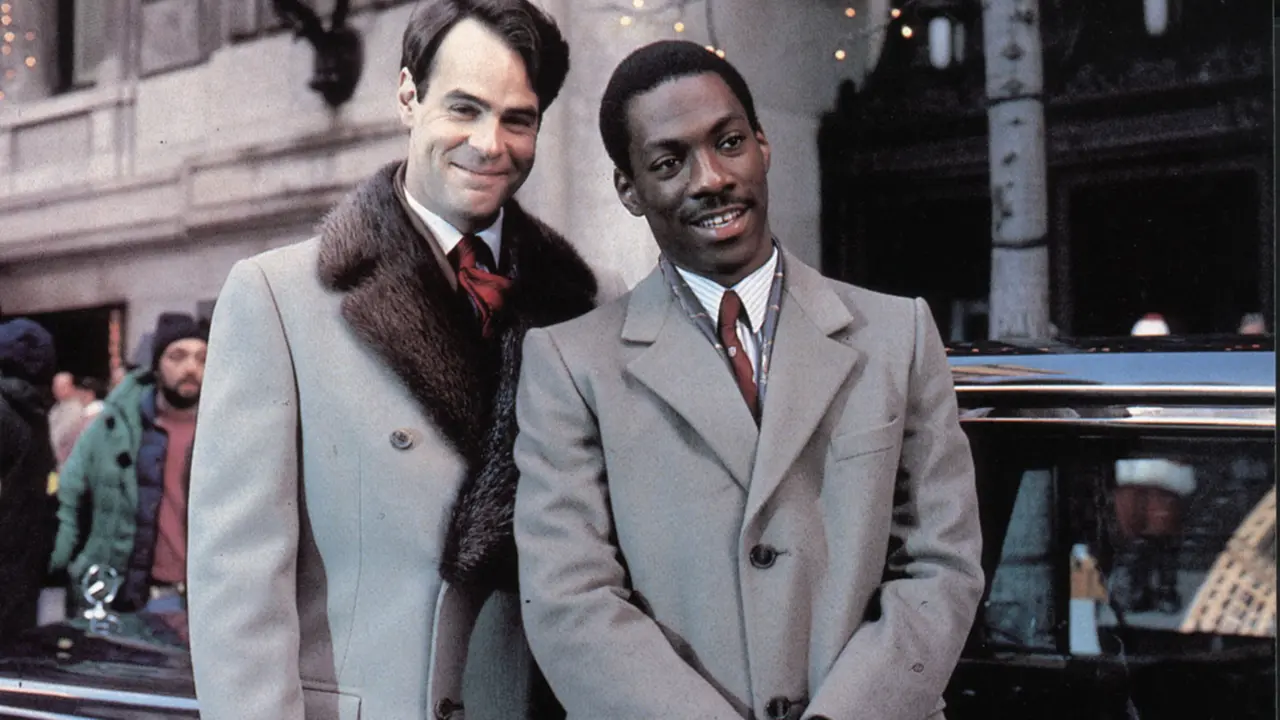
Those who watch it at Christmas tend to take it at face value: a highly accomplished comedy, memorable lines, Eddie Murphy and Dan Aykroyd on brilliant form. In reality, Trading Places is also one of the clearest and most unflinching accounts ever brought to the screen of how financial markets truly work. And of how dangerous they can become when one loses all sense of risk.
The story is well known. The Duke brothers, enormously wealthy owners of a commodities brokerage, decide to conduct a social experiment: to prove that success depends not on personal qualities but on environment. They deliberately ruin the life of Louis Winthorpe III, an elegant and apparently “perfect” manager, and put in his place Billy Ray Valentine, a small-time street con artist.
Their game, however, turns against them. When the two protagonists discover they were merely guinea pigs in a cynical wager, they resolve to take their revenge. And they do so by choosing the only truly effective means: striking the Dukes where it hurts most — in the market.
The heart of the film lies entirely in the final scene, set on the floor of the Philadelphia Commodities Exchange. Here, it is not equities that are traded, but contracts linked to raw materials — in particular, futures on frozen concentrated orange juice. A detail that seems technical, but is central to understanding everything.
The final scene: orange juice and the illusion of perfect information
The film’s climax plays out on the frantic floor of the Philadelphia Commodities Exchange, a setting that becomes, on screen, the perfect metaphor for the market itself: noise, speed, instinct, panic. The object of the confrontation is not equities or bonds, but futures contracts on frozen concentrated orange juice — a commodity whose price is acutely sensitive to one single, decisive variable: the weather in Florida.
In that market, a single word — frost — is enough to change everything. If cold threatens the harvest, future supply contracts and prices surge upward. If the climate is favourable, abundance drives quotations lower. It is on this elementary dynamic that the entire contest is played out.
The Duke brothers believe they hold the key to success: a confidential report from the Department of Agriculture, obtained illegally, which they claim heralds an imminent freeze. Convinced they possess a decisive advantage, they expose themselves without restraint, buying futures contracts at any price, themselves fuelling the upward rush.
Billy Ray Valentine and Louis Winthorpe, however, know the truth. They have the genuine report and know that the frost will not come. They wait, allow euphoria to inflate prices and, at the very moment the market runs in the wrong direction, make the only sensible move: they sell. They sell against the tide, betting on the collapse they know to be inevitable.
When the official data are finally made public, reality breaks in without warning. The market realises it has built a castle on thin air. Buying halts, selling multiplies, prices plummet. Those who entered convinced they knew everything find themselves trapped; those who had bet against the crowd collect their gains.
For the Duke brothers, it is not merely a loss. It is ruin. The contracts purchased at exorbitant prices are now worth a fraction of what was paid. Margin calls arrive immediately, implacably. Within minutes, their financial empire collapses under the weight of leverage and presumption — not because the market behaved “badly”, but because it simply did its job: punishing those who mistake information for certainty.
What are commodity futures, really?
Beyond the technical language and the frenetic trading floor scenes, a futures contract is a conceptually straightforward instrument. It is a formal, regulated and standardised agreement by which two parties commit today to exchanging a given commodity at a price already established, but at a future date. It is not a vague promise: it is a proper contract, with precise rules, defined quantities and fixed settlement dates.
In the film the example is orange juice, but the mechanism is identical for wheat, oil, gas or metals. The price is determined by the market at the moment the contract is traded, while delivery — in the vast majority of cases purely theoretical — is deferred in time. In practice, one decides today what something will be worth tomorrow — something that does not yet exist or has not yet been harvested.
These instruments were not born for gambling or speculation as an end in itself. Their original purpose is entirely concrete: to protect producers and end-users of commodities from price uncertainty. A farmer can lock in the value of his harvest in advance, sheltering himself from a collapse in quotations. A company can secure a stable cost for its supplies, preventing a sudden price surge from eroding margins.
It is only at a later stage that financial operators enter the picture — operators who have no interest whatsoever in the underlying commodity. They want neither sacks of wheat nor barrels of oil, let alone orange juice. Their objective is different: to capture price movements and profit from them. This is where the futures contract ceases to be a protection instrument and becomes an arena of competing expectations, information and risk — precisely as it does in the final scene of Trading Places.
Why futures are powerful instruments… and potentially destructive ones
Futures have always exerted a particular fascination because they amplify everything. Opportunities, correct intuitions — but also errors and illusions. Their power — and this is where the risk resides — lies in the ability to move enormous values with a relatively modest capital commitment. This is financial leverage: a multiplier that transforms a correct forecast into a significant gain, but one that makes an incorrect forecast capable of burning through capital in very short order.
What makes the picture even more unforgiving is the mechanism of daily settlement. In futures markets there is no luxury of “waiting for the storm to pass”. Every day the market settles its accounts and presents them immediately. If the price moves against the position taken, losses must be covered at once with additional margin. Not tomorrow, not at expiry: immediately. It is this that transforms a temporary error into an irreversible liquidity crisis.
Finally, there is perhaps the most underestimated aspect: information. Futures are instruments that live on expectations and data. Whoever operates on the basis of incorrect, incomplete or misinterpreted information exposes himself to enormous risk. And whoever, like the Duke brothers in the film, mistakes a supposed informational advantage for absolute certainty, discovers at their own cost that the market makes no distinction between naivety and arrogance. In both cases, the punishment can arrive within minutes.
Why the Duke brothers end in ruin
The fall of the Duke brothers is not the result of a simple miscalculation. It is something deeper and, precisely for that reason, far more instructive. Their error lies not merely in misreading the decisive data point, but in constructing an entire strategy upon an idea of infallibility. Convinced they possess the right information, they expose themselves without restraint, accumulating enormous positions and deploying leverage aggressively, as though the alternative scenario did not exist at all.
That supposed “privileged” information thus becomes a mental trap before it becomes a financial one. The Dukes plan no exit strategy, contemplate no error, cannot conceive of the market contradicting them. Everything is calibrated around a single possible direction — the one that should guarantee the profit. It is at that moment that risk ceases to be controllable.
When the price of orange juice collapses, reality manifests itself in its most brutal form. Margin calls arrive immediately and the Dukes cannot meet them. The contracts that were meant to make them even wealthier become a cage; losses grow faster than available capital, and the entire financial edifice collapses in on itself.
It is a dynamic that goes well beyond the film. That scene is the perfect representation of what happens when financial leverage is combined with absolute certainty that one is right. In the markets, there is no more explosive combination.
The film’s true message, more relevant today than ever
Trading Places still works so well because, beneath the surface of comedy, it tells a truth that markets continue to confirm every day. It is not merely a story of personal redemption or a satire on the cynicism of high finance; it is a lesson in behavioural finance at a time when that expression was not yet fashionable.
The film makes clear that markets do not punish error in itself, but arrogance. The conviction that one is always right, always a step ahead of others, is frequently the prelude to a fall. Information matters, certainly — but it becomes secondary if it is not accompanied by lucid, disciplined risk management. Without that, even the most valuable data loses its worth.
Leverage, moreover, is unmasked for what it truly is: an accelerator. It can enhance talent and the ability to read context, but at the same time it amplifies every misjudgement with ruthless efficiency. When one is overexposed, no supposed informational advantage is capable of saving the position.
This is precisely why, more than forty years after its release, the orange juice scene remains one of the most effective representations ever seen on screen of how a futures market truly functions. Not because it explains the technique, but because it conveys the essence: the fragile equilibrium between information, risk and human behaviour.